
Alessandro Michele
I think if you work with different kinds of codes, attitudes, in the end you have a language. It’s like within a person. You are not always the same.
Read more at: https://www.brainyquote.com/topics/codes
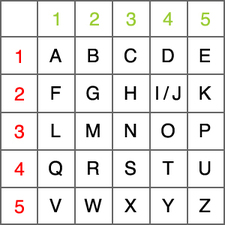
In cryptography, the Polybius square, also known as the Polybius checkerboard, is a device invented by the Ancient Greeks Cleoxenus and Democleitus, and perfected by the Ancient Greek historian and scholar Polybius,[1] for fractionating plaintext characters so that they can be represented by a smaller set of symbols.
Polybius did not originally conceive of his device as a cipher so much as an aid to telegraphy; he suggested the symbols could be signalled by holding up pairs of sets of torches. It has also been used, in the form of the “knock code” to signal messages between cells in prisons by tapping the numbers on pipes or walls. It is said to have been used by nihilist prisoners of the Russian Czars and also by US prisoners of war during the Vietnam War.
Arthur Koestler describes the code being used by political prisoners of Stalin in the 1930s in his anti-totalitarian novel Darkness at Noon. (Koestler had been a prisoner-of-war during the Spanish Civil War.) Indeed, it can be signalled in many simple ways (flashing lamps, blasts of sound, drums, smoke signals) and is much easier to learn than more sophisticated codes like the Morse code. However, it is also somewhat less efficient than more complex codes.
The simple representation also lends itself to steganography. The figures from one to five can be indicated by knots in a string, stitches on a quilt, contiguous letters before a wider space or many other ways.
 Learning Codes And Ciphers
Reblogged this on http://www.learningcodesandcipher.com and commented:
🙂
LikeLike